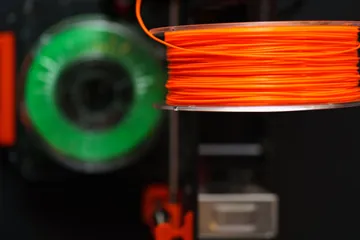

If you've just gotten a Bambu Lab printer like our P1S Combo, the filament store can be a little overwhelming. There are around 50 options, with names like PLA Basic, PLA Tough+, PETG HF and PAHT-CF. Which one do you actually need?
Here's the simple version. We'll go through each type of Bambu Lab filament, what it's good for, and whether it works on a P1S and in the AMS.
Why Picking the Right Filament Matters
Most of the time, the wrong filament still prints. The trouble shows up later:
- A PLA phone holder sags after a summer day in the car.
- A clip or bracket snaps the first time you use it.
- A big ABS print curls up off the build plate halfway through.
- A carbon fiber filament slowly wears out a regular nozzle.
Picking the right material up front saves you time, filament and a few headaches.
Bambu Lab Filament Types at a Glance
| Filament | Best for | Ease | P1S and AMS |
|---|---|---|---|
| PLA (Basic, Matte, Pure, Silk+) | Toys, figurines, gifts, decorations, organizers | Easiest | Yes and yes |
| PLA Tough+ | PLA parts that need to take a hit | Easy | Yes and yes |
| Specialty PLA (Sparkle, Galaxy, Marble, Metal, Wood) | Display pieces and gifts with a special look | Easy | Yes and yes |
| PETG (Basic, HF, Matte, Translucent) | Functional parts, planters, outdoor-ish items | Easy to medium | Yes and yes |
| TPU | Flexible parts: bumpers, grips, phone cases | Medium | Yes, but only "TPU for AMS" goes in the AMS |
| ABS and ASA | Car parts, things that get hot, outdoor parts | Medium | Yes and yes (enclosed printer needed) |
| PC | Very strong, heat-resistant parts | Harder | Yes and yes (dry it first) |
| Carbon and glass fiber (PLA-CF, PETG-CF, PA6-CF and more) | Stiff, strong, matte-looking parts | Medium to hard | Needs a hardened steel nozzle |
| Support materials (Support for PLA, PVA) | Clean, easy-to-remove supports | Easy | Yes and yes |
If you're just starting out, buy PLA. It's the cheapest, the easiest to print and comes in the most colors.
PLA: Where Everyone Should Start
PLA is the go-to filament for most home printing. It prints at low temperatures, doesn't warp much, and barely smells. We've printed dragons, toys and lots more with it.
The one thing to know: PLA softens in heat. Bambu lists PLA Basic's heat resistance at about 57°C (135°F), so don't leave PLA prints in a hot car or a sunny window.
Bambu sells a lot of PLA. Here's how the main ones differ:
- PLA Basic: The everyday PLA. Lots of colors, a slight shine, and one of the lowest prices. If you're not sure, get this one.
- PLA Matte: Same easy printing with a flat, non-shiny finish. It hides layer lines nicely, so prints look smoother and less "3D printed."
- PLA Pure: Newer, with a short list of ingredients that Bambu discloses. It carries toy-safety (EN 71-3) and low-emission (GREENGUARD) certifications, which makes it a nice pick for kids' toys and school projects. Bambu says its food-contact testing covers the raw materials, not finished prints, so we still wouldn't use prints for food.
- PLA Silk+ and Silk Multi-Color: Shiny and almost metallic. Great for vases and display pieces. The multi-color version shifts between colors along the spool.
- PLA Tough+: PLA that's much harder to break. Bambu's numbers show about three times the impact strength of PLA Basic. Good for clips, hooks and toys that get dropped.
- PLA Translucent: Lets light through. Fun for lamps, night lights and holiday decorations.
- Specialty PLA: Sparkle, Galaxy, Marble, Metal, Wood and Gradient each have their own look. They cost more, but they're just as easy to print.
- PLA Glow: Glows in the dark. Bambu says it needs a hardened steel nozzle, and they don't recommend running it through the AMS.
- PLA Aero: A lightweight PLA made for things like RC airplanes. Pretty specialized.
Shop Bambu Lab PLA Basic on Amazon
PETG: Tougher and More Heat Resistant
PETG is the next step up. It's stronger and handles heat better than PLA, so it's a good choice for parts that actually get used: brackets, clips, planters, tool holders and things that sit outside.
It's still easy to print, but it strings a bit more than PLA, and it soaks up moisture faster.
- PETG Basic: The general-purpose PETG. Bambu's specs show it's a little stronger than PETG HF.
- PETG HF: "HF" stands for high flow. It's made to print faster. Bambu says it must be dried before use and kept with desiccant while printing.
- PETG Matte: New, with a flat finish like PLA Matte.
- PETG Translucent: See-through colors, nice for light covers and decorations.
- PETG-CF: PETG with carbon fiber for stiffer parts. Needs a hardened steel nozzle (more on that below).
TPU: Flexible Filament
TPU is rubbery and bendy. Use it for phone cases, bumpers, grips, feet for furniture, and anything that needs to squish.
Bambu has a few kinds, and this is where it gets a little confusing:
- TPU for AMS: A firmer TPU (68D) that Bambu made specifically so it can feed through the AMS. It's less bendy than the others, but much more convenient.
- TPU 95A HF: The classic flexible TPU, made to print faster. Feed it from the external spool holder, not the AMS.
- TPU 85A and 90A: Even softer and stretchier. Also external spool only.
All TPU needs to be dry before printing. Bambu marks drying as required for TPU.
ABS and ASA: For Heat and the Outdoors
ABS and ASA handle heat much better than PLA or PETG. They're good for car parts, things near a heater or motor, and outdoor parts. ASA also resists the sun, so it won't fade or get brittle as quickly outside.
The catch is that they warp if the air around the print cools too fast. Bambu recommends an enclosed printer for them, and the P1S is enclosed, so it's a good match. They also smell when printing, so ventilate the room. Our P1S review covers fumes and the HEPA filter upgrade.
Bambu also makes ABS-GF and ASA-CF (with glass and carbon fiber), plus ASA Aero, a lightweight ASA. The fiber versions need a hardened steel nozzle.
PC: Strong and Heat Resistant
Polycarbonate (PC) is one of the strongest and most heat-resistant filaments you can print at home. It's great for tough mechanical parts. It also needs higher heat, an enclosed printer, and it must be dried before printing. There's also PC FR, a flame-retardant version.
PC isn't where we'd start, but it's nice to know the P1S can handle it.
Carbon Fiber and Glass Fiber Filaments
Filaments with "-CF" (carbon fiber) or "-GF" (glass fiber) in the name have tiny fibers mixed in. That makes parts stiffer and stronger, with a nice matte look.
Those fibers are also abrasive. They need a hardened steel nozzle. The P1S comes with a stainless steel nozzle, so you'd need to swap in Bambu's hardened steel hotend first.
The easier fiber filaments are PLA-CF and PETG-CF. The rest are engineering materials that most home users won't need:
- PA6-CF, PAHT-CF and PA6-GF: Nylon blends. Very strong and heat resistant, but they must be dried and kept dry.
- PET-CF: Very stiff and heat resistant. Not AMS compatible.
- PPA-CF: High-end engineering material that prints very hot. Not AMS compatible, and worth checking Bambu's page before buying it for a P1S.
- PPS-CF: Bambu lists it for the H2 series and X1E only, so it's not for the P1S.
Support Materials
When a model has overhangs, the printer builds supports under them. Bambu's support materials make those supports come off cleanly.
- Support for PLA, and Support for PLA/PETG: Used as a thin layer between the support and your print, so the supports pop right off with a smooth surface underneath. With the AMS, the printer can swap to it for just those layers.
- PVA: Dissolves in water. Great for complicated shapes where you can't reach the supports. It's very sensitive to moisture, so keep it dry.
- Support for ABS and Support for PA/PET: The same idea, for those materials.
What the P1S Can Print
Good news if you have a P1S: it can print almost everything Bambu sells. Here's the short list of exceptions:
- Carbon fiber, glass fiber and PLA Glow need a hardened steel nozzle swap.
- TPU 95A HF, 85A and 90A feed from the external spool, not the AMS.
- PET-CF and PPA-CF can't go in the AMS.
- PPS-CF isn't for the P1S at all.
Whatever You Pick, Keep It Dry
All filament picks up moisture from the air, and damp filament causes stringing, popping and weak prints. Bambu says PETG HF, PVA, PC, TPU and the nylon blends must be dried before use and kept with desiccant while printing.
We keep our spools in sealed boxes with silica and a humidity monitor. Here's how we keep our filament dry, and why our AMS needed extra silica gel.
Bambu Filament FAQ
Do I have to use Bambu filament in a Bambu printer?
No. Any standard 1.75 mm filament works. Bambu filament has an RFID tag, so the AMS recognizes the type and color automatically and picks the right settings. With other brands, you just choose the filament type yourself.
What's the difference between PLA Basic and PLA Matte?
Mostly the finish. Basic has a slight shine, and Matte is flat. Matte hides layer lines better. Both are just as easy to print.
Which filament is best for outdoor prints?
ASA is the best pick because it resists the sun. PETG is a good, easier choice for things that don't sit in direct sun all day.
Is PLA food safe?
We wouldn't count on it. Even when the material is tested, the tiny gaps between layers can hold bacteria. Stick to decorations, toys and tools.
The Bottom Line
Start with PLA Basic or PLA Matte. They're cheap, easy and come in every color. When you need a part that's tougher or handles heat, move up to PETG. Grab TPU for bendy parts, and ABS or ASA for heat and the outdoors. The carbon fiber and engineering filaments are fun to try later, once you add a hardened steel nozzle.
If you're still shopping for a printer, see why we chose the Bambu Lab P1S Combo.