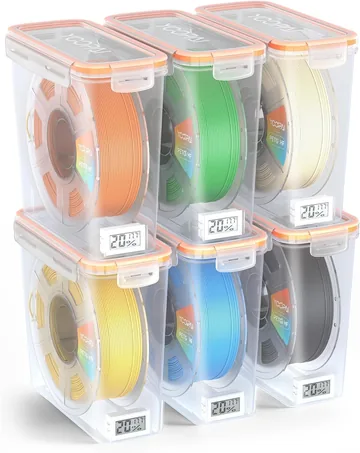

Once we got our Bambu Lab P1S Combo, the filament started piling up fast. The AMS only holds four spools, and the rest needed somewhere dry to live.
We picked up this 6-pack of YOOPAI filament storage boxes, and we really like them. Each box holds one spool plus silica packs, seals up tight, and has a little screen on the front that shows the humidity and temperature inside. Our spools went from about 40% humidity to between 10 and 16%.
See the YOOPAI Filament Storage Boxes on Amazon
Why Humidity Is Bad for 3D Printer Filament
Filament soaks up moisture from the air. You can't see it happening, and a damp spool looks exactly like a dry one.
The trouble shows up when you print. When damp filament hits the hot nozzle, the water inside turns to steam. You'll notice:
- Popping or crackling sounds while it prints
- Stringing and wispy hairs between parts
- Rough, bubbly or fuzzy surfaces
- Weak prints where the layers don't stick together well
- Brittle filament that snaps on the spool or in the AMS
PLA is fairly forgiving. PETG, TPU and nylon soak up moisture faster and show it sooner. Either way, the fix is the same: keep your spools sealed up with desiccant, somewhere you can check the humidity. That's exactly what these boxes do.
YOOPAI Storage Boxes at a Glance
| What you get | 6 clear storage boxes, each with its own lid |
|---|---|
| Fits | One standard 1 kg spool of 1.75 mm filament per box (PLA, PETG, ABS, TPU and so on) |
| Seal | Silicone gasket in the lid, with snap-down clips on all four sides |
| Monitor | A small digital thermo-hygrometer built into each box |
| Desiccant | Reusable desiccant packs included |
| Extras | Label slots, and a flat top so they stack |
| Price | $44.99 for six when we checked, or about $7.50 a box |
The filament in the photo isn't included. You're just buying the boxes.
What We Like
Room for the spool and the silica
The box is shaped to fit a 1 kg spool without a lot of wasted space, but there's still room underneath and around the sides for silica packs. We fit the packs that came with the boxes plus some of our own, and the lid still closed and clipped shut with no trouble.
The built-in humidity monitor
This is our favorite part. Each box has a small digital display that shows both the humidity and the temperature. A gadget that does both is called a thermo-hygrometer, which is a mouthful, so we just call it the humidity monitor.
It means you can walk by the shelf and see how dry each spool is without opening anything. Every time you pop a lid, room air gets in, so not having to open them to check is a big deal.
You can see what's inside
The boxes are clear, so you can spot the color you want at a glance. There are also label slots if you'd like to mark the material or brand. That helps when you have two spools that look alike but one is PLA and one is PETG.
They stack
The lids are flat, so the boxes stack neatly on a shelf or workbench.
Good value
For around $7.50 a box, you get an airtight container, a humidity monitor and desiccant. The monitor alone would cost a few dollars if you bought it separately.
Unboxing: Getting Them Apart Was the Hard Part
Each box came in its own plastic bag, but they were nested inside each other to save space. Getting them apart was really hard.
If yours are stuck too, be patient. Work them apart slowly and evenly instead of prying hard on one corner, since the walls aren't very thick.
How Sturdy Are They?
The plastic isn't super thick. Once the lid is on and clipped down, though, the box firms up, and they're sturdy enough for stacking spools on a shelf, which is all we need them to do. We wouldn't toss them around or use them as a step stool, but for sitting on a shelf next to the printer, they're fine.
Our Results: 40% Down to 10 to 16%
When we first put our spools in the boxes, the monitors read about 40% humidity.
Each box came with desiccant packs, so we put those in. Then we added some of the rechargeable silica gel packets we use in our AMS. After that, the boxes settled in at 10 to 16% humidity.
The empty box test
We were curious how well the included packs work on their own, so we tried one more thing. We closed up an empty box with just the packs that came with it, no filament and no extra silica. It went all the way down to 10%.
That tells us two things. The included packs are good, and the seal really does keep room air out. It also shows that the filament itself brings moisture in with it, which is why the boxes with spools in them needed the extra silica to get to the same range.
Is 10 to 16% Humidity Too Dry for Filament?
We wondered about this too. The short answer is no, 10 to 16% is great. We're keeping all the packs in.
- Bambu Lab recommends storing filament below 20% humidity, and 10 to 16% is comfortably under that.
- Room-temperature silica won't hurt your filament. Stringing, popping and brittle filament come from too much moisture, not too little.
- PETG, TPU and nylon are the most sensitive to moisture, so they benefit the most from staying this dry. PLA is more forgiving, but drier is still better.
One thing to keep in mind: small built-in monitors like these are good for watching trends, but they aren't lab instruments. A few percent of difference between boxes might just be the monitors. What matters is that they're all low and staying low.
Tips for the Desiccant Packs
YOOPAI's FAQ says one desiccant pack per box is enough, and two absorb more. We'd go with two, or add your own silica like we did, especially if your house is humid.
- Watch the color. YOOPAI says their packs start turning purple when they've absorbed moisture. That's your sign to replace or recharge them.
- Recharging: YOOPAI says you can dry the packs on the printer's heated bed or carefully in the microwave. Take them out of the box first. The box and the humidity monitor should never go in the microwave.
- Watch the monitor. If a box starts creeping up toward 20% or higher, the silica in that box is probably getting full.
- Keep a spare set ready so you can swap in fresh silica right away and recharge the old packs when you have time. Our silica gel guide has step-by-step recharging tips.
Things to Know Before You Buy
- The temperature only shows in Celsius. There's no Fahrenheit setting. For reference, 20°C is 68°F and 25°C is 77°F.
- They're made for standard 1 kg spools. Bigger spools won't fit.
- They keep filament dry, but they don't dry it out. If a spool is already damp, run it through a filament dryer first, then store it in the box.
- The walls are thin, as we mentioned above. Sturdy enough with the lid on, but not heavy duty.
- Plan some time to separate them when they arrive.
Filament Storage Box FAQ
What humidity should I store filament at?
Bambu Lab's target is under 20%. Our boxes sit between 10 and 16%, which is right where we want them.
Can I use my own silica gel?
Yes. There's room for extra packs next to the spool. We added the rechargeable silica packets from our AMS setup, and that's what got our filled boxes down from 40%.
Do I still need these if I have an AMS?
If you have more than four spools, yes. The AMS only holds four at a time, and these boxes keep everything else dry until it's time to load it.
The Bottom Line
These YOOPAI boxes are a great value. Each one holds a spool and plenty of silica, seals tight, and shows you the humidity without opening the lid. They're a little thin and a real pain to pull apart when they arrive, but once the lids are on, they do exactly what we wanted. Our filament is sitting at 10 to 16% humidity, and we can check it any time with a glance at the shelf.
If you have a 3D printer and more spools than your printer can hold, these are an easy pick.